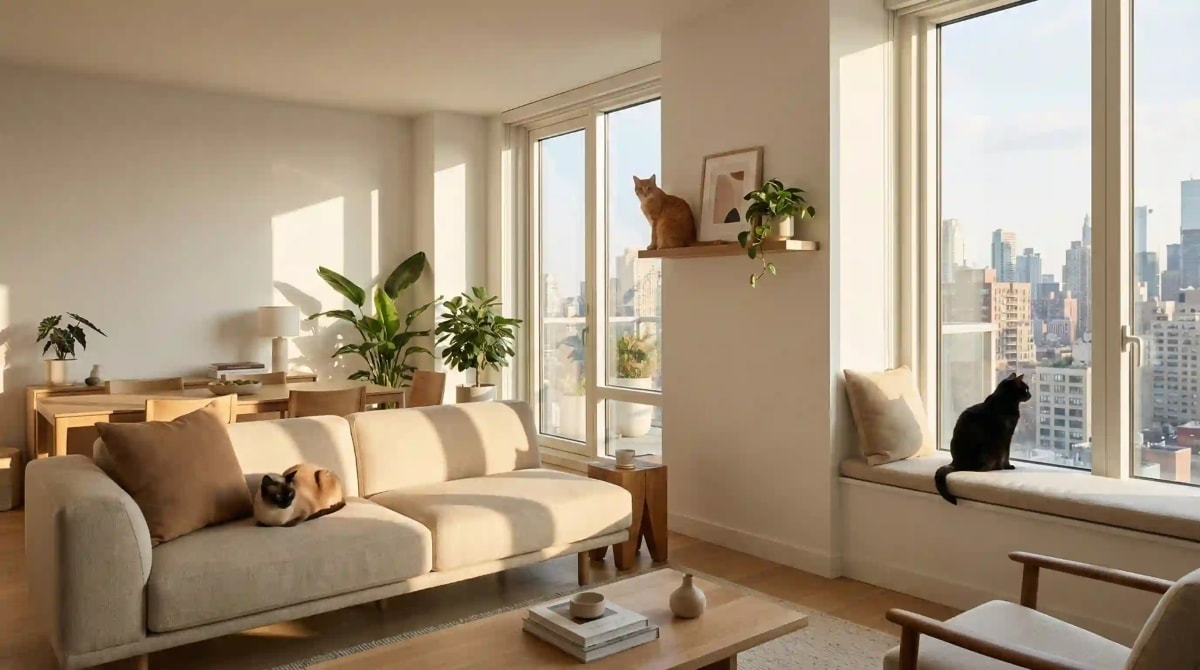
The "Three-Cat Leap" is a real phenomenon in the pet world. While moving from one cat to two often feels like a natural progression, adding a third feline to a compact apartment changes the social and spatial dynamics of your home completely.
In an urban setting, the question isn't just about whether you have enough love to give. It is about whether your square footage can handle the complex "resource math" that three cats require to coexist without stress.
Key Takeaways
- The N+1 Rule: You need 4 litter boxes for 3 cats, which is a major space commitment in an apartment.
- Vertical Territory: A 600 square-foot apartment can feel like 1,000 square feet to a cat if you utilize wall space effectively.
- Social Dynamics: Three cats create a "colony" structure, which can lead to shifting alliances and potential bullying.
- The Odor Factor: Managing waste for three cats in an enclosed space requires a high-frequency cleaning protocol.
Medical Disclaimer
The content on InnerMeow is for informational and educational purposes only. It is not intended to provide medical advice or to take the place of such advice or treatment from a personal veterinarian. All readers/viewers of this content are advised to consult their veterinarians or qualified health professionals regarding specific health questions. InnerMeow does not take responsibility for possible health consequences of any person or pet reading or following the information in this educational content.
1. The Geometry of Feline Space
Cats do not measure an apartment by floor space. They measure it by "territorial paths." In a small home, three cats can easily lead to a "traffic jam" where one cat blocks another’s access to the litter box or food bowl, even without intending to.
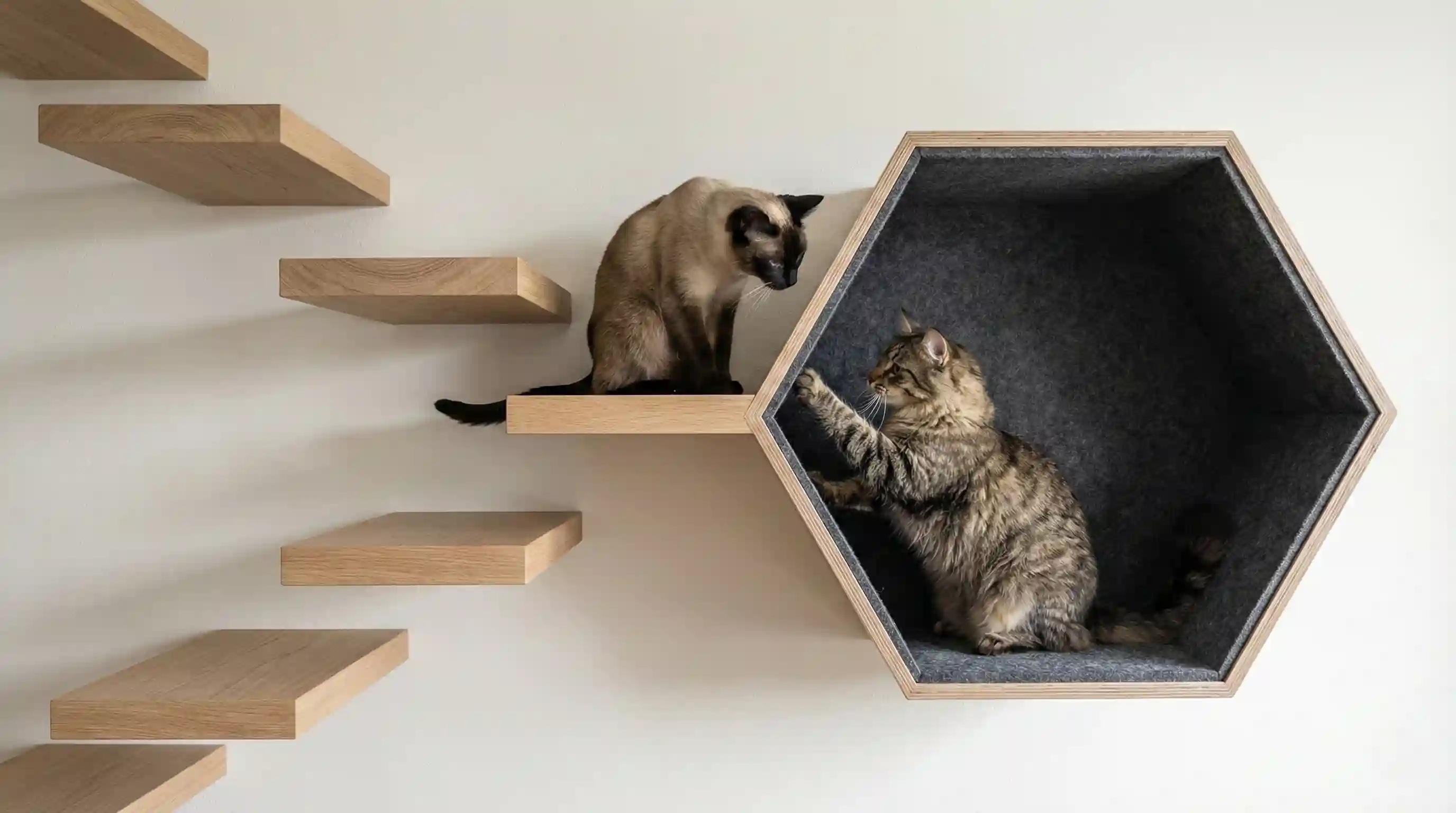
To make three cats work, you must maximize vertical space. This isn't just a luxury: it is a biological necessity. Elevated shelves allow a lower-ranking cat to bypass a higher-ranking one without a physical confrontation.
2. The Resource Math: N+1
The biggest challenge of the three-cat apartment is the litter box situation. Behavioral experts recommend the "N+1" rule, which means one box per cat, plus one extra.
For a trio, that means four litter boxes. In a one-bedroom apartment, finding four discreet, well-ventilated spots for waste can be nearly impossible. Failing to provide enough boxes often leads to "inappropriate elimination," where cats begin marking your bed or rug to reclaim their space.
The Good
- + Built-in social circle: cats are less likely to be lonely when you are at work.
- + Dynamic play: three cats often engage in more varied social play than a pair.
- + Feline harmony: if two cats have a disagreement, the third often acts as a social buffer.
The Bad
- - Exponentially higher vet costs and insurance premiums.
- - Higher risk of 'contagious stress' if one cat becomes ill or anxious.
- - Odor management becomes a daily, high-stakes battle in small spaces.
3. Comparing Capacity: 1, 2, vs. 3 Cats
How does the workload and space requirement change as you add to your urban pride?
| Requirement | 1 Cat | 2 Cats | 3 Cats |
|---|---|---|---|
| Litter Boxes | 2 | 3 | 4 |
| Feeding Stations | 1 | 2 (separated) | 3 (distinct zones) |
| Vertical Needs | Low | Moderate | Extreme (Wall systems needed) |
| Daily Cleaning | 5 mins | 15 mins | 30+ mins |
4. Signs Your Apartment is Overcrowded
How do you know if you have crossed the line? Feline stress is subtle. Look for these "Feline Social Fatigue" indicators:
- Staring Contests: One cat sits in a doorway, silently preventing another from passing.
- Over-Grooming: A cat licks their belly raw due to the constant presence of other cats.
- Hiding: One cat spends 90% of their time on top of the fridge or under the bed to avoid interaction.
- The Odor Shift: Even with daily scooping, the apartment has a persistent ammonia scent.
5. The Verdict: Is It Possible?
Three cats can thrive in an apartment, provided the owner is intentional about "Catification." This means trading your minimalist decor for cat trees, wall shelves, and multiple scratching posts.
If you are unwilling to let your apartment look like a "cat playground," then three is likely too many. However, if you are happy to build upwards and maintain a rigorous cleaning schedule, a trio of cats can provide a lively, loving urban sanctuary.
For more on managing a multi-cat home, check our latest insights on Cat Behavior or visit the Living Section for space-saving hacks.
How much space do you need for 3 cats?
Experts recommend at least 18 square feet of "territory" per cat, but vertical space counts. A 600 sq ft apartment is fine for 3 cats IF you have cat trees and shelves. Without vertical options, they will feel crowded.
How to manage 3 cats in a 1 bedroom apartment?
Zone defense is key. Create "Time Out" zones (like the bedroom or bathroom) where a cat can retreat. Stick to a strict cleaning schedule for litter boxes, as odor builds up 3x faster in small air volumes.
Is having 3 cats crazy?
No, but it is a "Colony." Two cats are a pair; three is a social group. The dynamic changes, and you will see more complex behaviors like alliances and bullying. It requires more active management than a pair.
Frequently Asked Questions
There is no hard number, but most experts suggest at least 200 square feet of 'usable territory' per cat. If you have a 600 sq ft apartment and utilize walls, you are well within the healthy range.
Yes. In a three-cat household, eating side-by-side can cause 'silent stress.' Place bowls in different corners of the room, or even different rooms, to allow them to eat without feeling guarded.
Automatic boxes like the Litter-Robot are a lifesaver for 3 cats, but they do not replace the N+1 rule entirely. You should still have at least one traditional box as a backup to prevent territorial guarding of the robot.