It is the most confusing betrayal in the pet world.
You are sitting on the couch, petting your cat. They are purring. They seem to be in heaven. Then, with zero warning-SNAP. They sink their teeth into your hand, kick you with their back legs, and bolt across the room.
You are left bleeding and wondering: "Why does my cat hate me?"
The truth is, they don't hate you. Biting is one of the most complex words in the feline vocabulary. It can mean "I love you," "I'm bored," or "Stop touching me right now." Unlike dogs, who use their mouths almost exclusively for eating and fighting, cats use their mouths for delicate social communication.
To stop the biting, you first have to learn the language.

Key Takeaways
- The "Stop" Button: Most bites during petting are due to overstimulation, not anger.
- The Prey Drive: Ankle biting is a sign of a bored hunter with no outlet.
- The Grooming: Chewing your hair is a social bonding ritual (Allogrooming).
- The Self-Bite: Biting their own tail or paws is a medical red flag for pain or parasites.
1. The "Static" Trap (Petting-Induced Aggression)
This is the #1 reason owners get bitten.
Cats have extremely sensitive hair follicles. When you pet them repetitively in the same spot (especially down the spine or near the tail), the sensation changes rapidly. It goes from "pleasant tickle" to "painful static electricity" or intense irritation.
Imagine someone tickling your foot. It is funny for 5 seconds. It is annoying at 10 seconds. At 20 seconds, you want to kick them in the face.
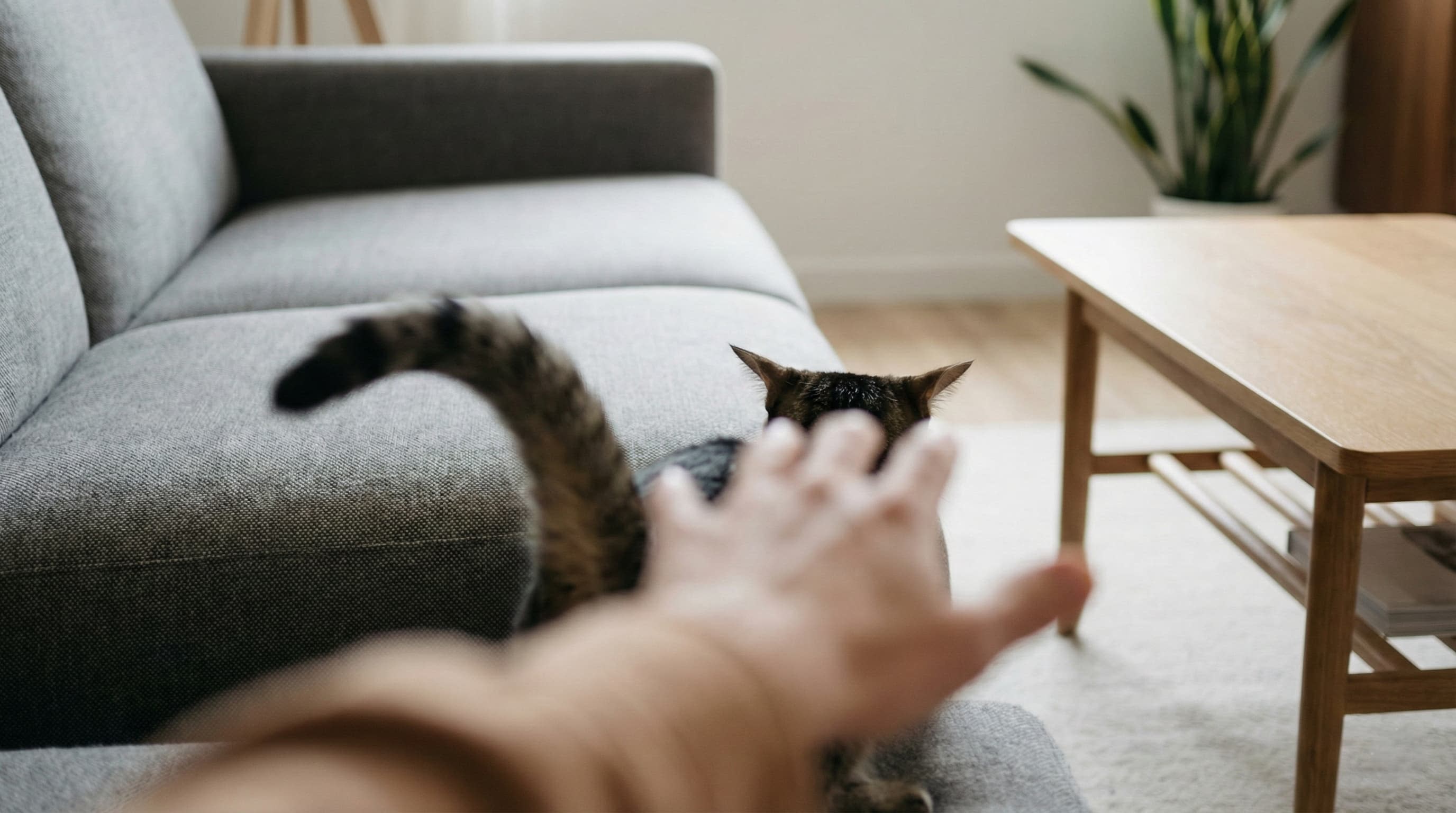
The "Warning Shot" Signs: Your cat didn't bite out of nowhere. They gave you at least three warnings that you missed:
- The Tail: The tip started twitching or thumping.
- The Skin: You saw a ripple (twitch) go down their back.
- The Ears: They rotated sideways (airplane mode).
When you ignored these polite requests to stop, the bite was their way of shouting "ENOUGH!"
2. The Ankle Hunter (Play Aggression)
Does your cat lie in wait under the sofa and ambush your feet when you walk by?
This is Predatory Drift. In the wild, cats hunt things that move across the ground. Your walking ankles look exactly like a wounded rabbit or mouse.
If your cat is an indoor-only pet with no hunting outlet, they must discharge that predatory energy somewhere. Unfortunately, your legs are the only moving target available. This isn't aggression; it is boredom.
The Fix: Do not yell. That makes the "prey" seem more exciting (it squeaks!). Instead, carry a wand toy or toss a mouse ahead of you to redirect that hunting instinct onto an appropriate target.

3. The Aggressive Barber (Hair Chewing)
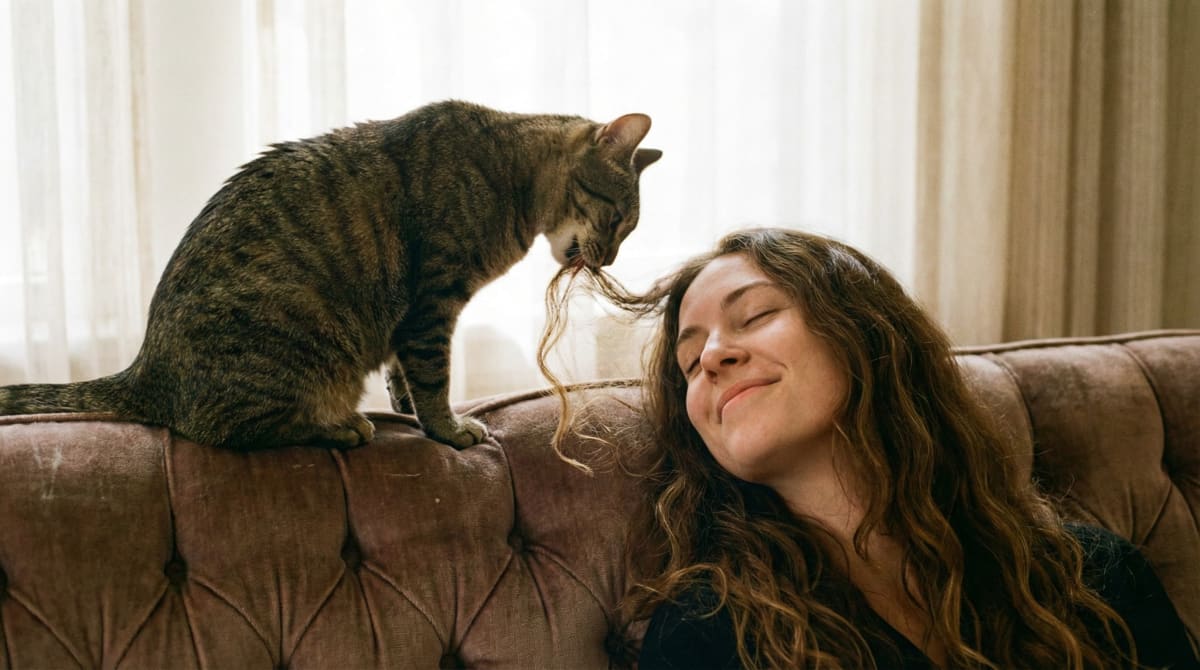
You wake up to your cat chomping on your hair. Or you are watching TV and they start aggressively licking and nibbling your scalp.
This is Allogrooming (social grooming). In a cat colony, cats groom each other to reinforce bonds and establish a "family scent." By chewing your hair, they are cleaning you. They are treating you like a giant, clumsy kitten that can't groom itself properly.
It is a huge compliment, even if it leaves you with cat spit in your bangs.
4. The "Blanket Biscuit" (Comfort Nursing)
If your cat bites a blanket or your sweater while kneading and purring, they are reverting to kittenhood.
This is called Wool Sucking. Kittens knead and suckle to get milk. Some adult cats retain this behavior as a self-soothing mechanism, especially if they were weaned too early. It releases endorphins and calms them down. Unless they are actually eating the fabric (Pica), this is a harmless and sweet habit.
5. The Red Flag: Self-Mutilation
Is your cat biting themselves?
If you see your cat aggressively chewing their own tail, paws, or base of the spine, this is a medical emergency, not a behavior issue.
- Fleas: A single flea bite can cause an allergic reaction that feels like fire.
- Arthritis: They bite the joint that hurts to try and "remove" the pain.
- Hyperesthesia Syndrome: A neurological condition where the skin becomes hypersensitive, causing them to attack their own tail.
Play vs. Aggression: How to Tell?
Not all bites are created equal. Here is how to know if you are in a game or a fight.
The Good
- + Ears: Forward or sideways
- + Claws: Retracted (soft paws)
- + Bite: Pressure is controlled (inhibited)
- + Sound: Silent or quiet chirps
- + Body: Loose, rolling around
The Bad
- - Ears: Pinned flat back against head
- - Claws: Fully extended
- - Bite: Breaks skin, punctures
- - Sound: Growling, hissing, spitting
- - Body: Tense, hackles raised (puffed up)
Why does my cat bite me gently?
"Love bites" are gentle uncontrolled nibbles that happen during grooming or intense affection. Unlike aggressive bites, they don't break the skin. It is your cat's way of claiming you, similar to how a mother cat carries a kitten.
How to stop a cat from biting when petted?
The key is to watch for "The Static Trap." If you see the tail twitch or skin ripple, stop petting immediately. Do not punish them. Simply freeze and withdraw attention. This teaches them that biting makes the "good stuff" (you) go away.
Is it normal for kittens to bite a lot?
Yes. Kittens explore the world with their mouths (Teething). However, you must teach them "Bite Inhibition" now. If they bite your hand, make a high-pitched "Ow!" sound and stop playing. Never use your hand as a toy, or they will grow up thinking hands are prey.
Final Thoughts
A bite is rarely an act of malice. It is a request for space, a desperate attempt to play, or a sign of pain.
The next time you feel teeth, freeze. Don't pull away (that triggers the chase instinct). Go limp. Look at what happened right before the bite. Your cat just gave you a piece of information. It is up to you to listen.
Frequently Asked Questions
No. Punishment creates fear. If you spray them, they won't learn 'don't bite'; they will learn 'that person is scary and unpredictable.' This destroys trust and can actually make aggression worse.
This is a 'Love Bite.' It is a mix of affection and grooming. They nip to grab hold (like a mom carrying a kitten) and then lick to soothe. It means they feel extremely close to you.
Redirect. If they are in play mode, throw a toy. If they are overstimulated, simply stand up and walk away. Removing your attention is the most powerful signal that biting ends the fun.