If you have three cats in a small apartment, the litter box question stops being theoretical very quickly.
You are no longer asking, "Where should I put the box?" You are asking, "How do I fit enough boxes in here without making the whole place smell like a public restroom?"
The short answer is simple: three cats usually need four litter boxes.
That is the N+1 rule. One box per cat, plus one extra. It sounds excessive until you live through one cat guarding a hallway box, another refusing to pee in a dirty tray, and the third deciding your laundry basket is now part of the system.
In a small apartment, the challenge is not just the number. It is the placement, the cleaning routine, and the way those boxes affect the cats' sense of safety.
Key Takeaways
- The usual rule is 4 boxes for 3 cats: One per cat, plus one extra.
- Different rooms help, but separate zones also work: In a small apartment, visual separation matters almost as much as distance.
- Do not line every box up in one corner: That turns multiple boxes into one shared bathroom zone.
- If four full boxes is impossible, your fallback must be stronger: Bigger boxes, stricter cleaning, and better spacing become non-negotiable.
1. Yes, The Standard Answer Is 4
For three cats, the standard recommendation is four litter boxes.
This is not random internet advice. The point of the extra box is to reduce pressure around access. Cats do not just care whether a box exists. They care whether they can reach it without being watched, blocked, crowded, or forced to use one that already smells wrong.
That matters even more in a small apartment, because every doorway and hallway becomes part of the social map.
If one cat likes to sit near the bathroom entrance, that can quietly turn a "shared" litter box into a guarded resource. On paper, you still have enough boxes. In practice, one cat may feel like they do not.
If you are still deciding whether three cats is even workable in your space, read this first:
2. Why 3 Boxes Often Fails In Real Life
On paper, three boxes for three cats can look fair.
In a real apartment, it often breaks down because cats do not use resources evenly.
One box may become the favorite for poop. Another may be the "safe pee box." Another may sit too close to noise, food, or foot traffic, so it only gets used when a cat has no better option.
That is why the extra box matters. It gives the group more breathing room when preferences clash.
With three cats, the litter box problem is rarely just about waste. It is about traffic flow.
You are trying to avoid:
- one cat waiting outside a box
- one cat getting ambushed after using it
- one cat deciding the box is too stressful and choosing your rug instead
3. The Real Rule In A Small Apartment
If you live in a studio or one-bedroom apartment, the practical rule is this:
Do not think in terms of "four boxes." Think in terms of "four usable bathroom options."
That may include:
- three full-size open boxes
- one larger backup box in a quieter corner
- one box inside a furniture enclosure if your cats tolerate it
What does not work well is placing four trays shoulder to shoulder in the same laundry nook and calling it solved.
If all four boxes are in one tight cluster, many cats will experience that as one bathroom zone, not four separate choices.
4. The Best Layout For 3 Cats In A Small Apartment
Here is the setup that usually works best:
| Zone | What Goes There | Why It Helps |
|---|---|---|
| Primary quiet zone | 2 boxes, spaced apart | Gives the group a reliable main bathroom area |
| Secondary retreat zone | 1 box | Gives a shy or lower-confidence cat another option |
| Backup zone | 1 box | Helps when one box is dirty, guarded, or busy |
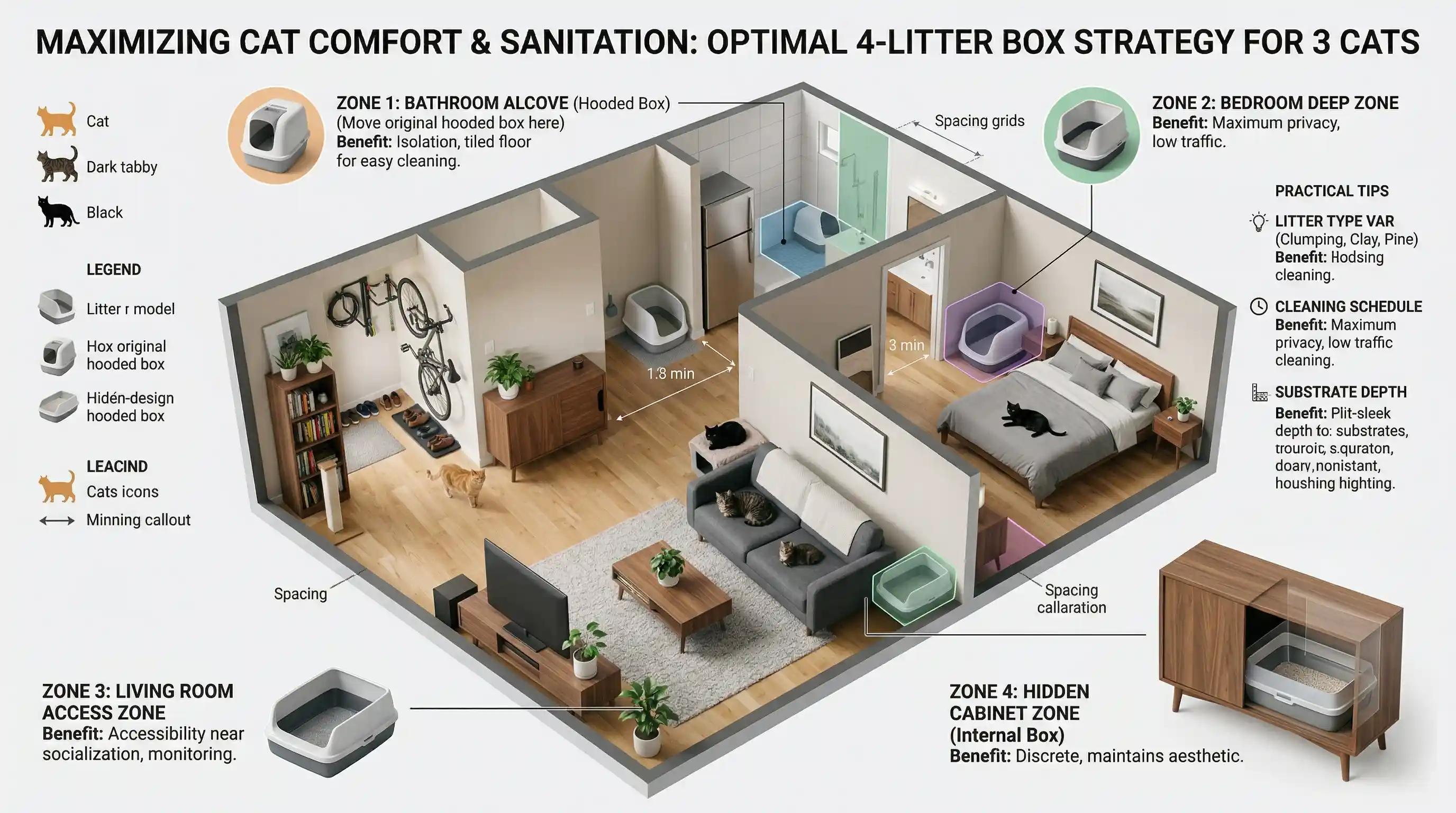
In a one-bedroom apartment, that may look like:
- one box in the bathroom
- one box in a living room corner hidden by furniture
- one box in the bedroom if a cat already treats it as a safe room
- one box in a modified cabinet or closet zone
The goal is not symmetry. The goal is choice.
If you need better hiding strategies for the boxes themselves, this article is the natural companion:
5. Where People Usually Get It Wrong
The most common mistake is trying to keep all the litter problem in one tiny corner of the apartment.
That feels tidy to the human. It often feels risky to the cats.
Other common mistakes:
Putting a box right beside food
Cats prefer separation between toilet space and feeding space.
If you are still working out food placement, start here:
Using boxes that are too small
When space is tight, people often buy compact trays. That usually makes things worse. Three cats need larger, not smaller, bathroom surfaces.
Cleaning on a "normal" schedule
Three cats do not create one-cat waste at triple speed. In a small apartment, it feels worse than that because the air volume is low and the odor has nowhere to go.
If you have three cats, scooping once a day is usually not enough.
6. What To Do If You Truly Cannot Fit 4
Sometimes the honest answer is that four full boxes just do not fit.
If that is your reality, do not pretend three cramped trays are "basically the same." They are not. You need to compensate.
Your fallback plan should look like this:
- Use the biggest boxes you can fit
- Scoop at least twice a day
- Keep the boxes in different traffic conditions
- Use litter with strong odor control
- Watch for behavior changes fast
That last part matters. If one cat starts hesitating, peeing elsewhere, or waiting too long, your setup is already under strain.
For litter material and odor-control tradeoffs, this helps:
7. Signs Your Current Setup Is Not Working
Even if your apartment still looks clean, your cats may already be telling you the litter setup is too tight.
Watch for:
- a cat waiting for another to leave the area
- one cat always using the same single box
- poop or pee outside the tray
- a cat racing away after using the box
- sudden tension in hallways or doorways
Sometimes the problem is not the number of boxes. It is the fact that one shy cat does not feel safe walking to them.
That is why enrichment and vertical escape routes matter in a three-cat apartment too:
8. The Setup That Usually Works Best
If you want the cleanest practical answer, it is this:
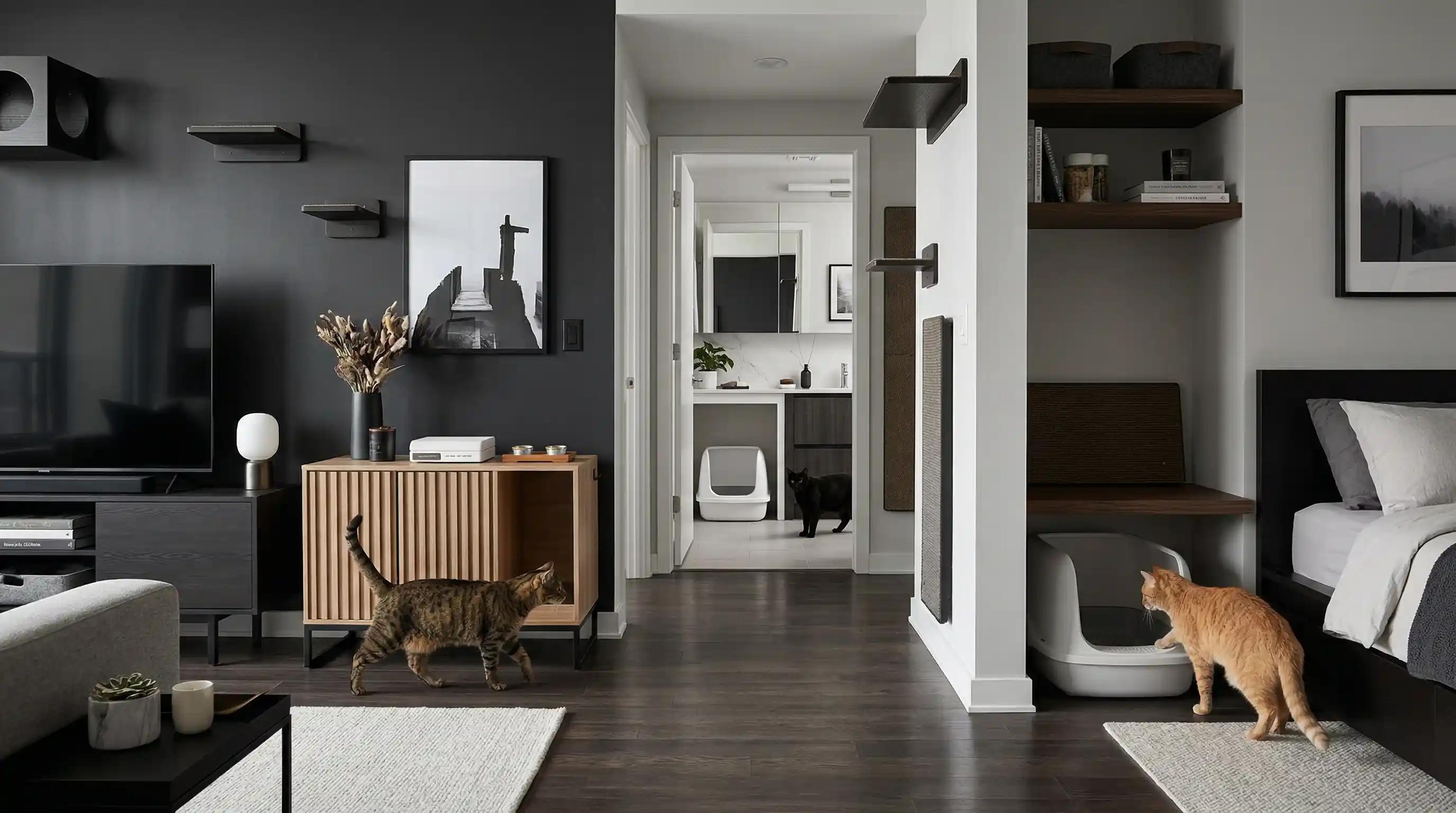
For 3 cats in a small apartment, aim for 4 litter boxes in at least 3 different zones.
That is the version of the N+1 rule that usually holds up in real life.
It gives you:
- one box that can be temporarily busy
- one box that can be temporarily dirty
- one cat that wants privacy
- another cat that wants the familiar favorite spot
In other words, it gives the group enough slack to keep small tensions from becoming house-soiling problems.
Final Thoughts
The right answer for three cats in a small apartment is usually four litter boxes, not because cats love complicated rules, but because shared resources create pressure fast.
If you cannot fit four, the real question becomes whether your cleaning routine, box size, and placement are good enough to make up the gap.
Sometimes they are. Sometimes they are not.
But if you start with this idea, you will make better decisions:
Three cats do not need four boxes because they are difficult. They need four boxes because small spaces make resource tension show up faster.