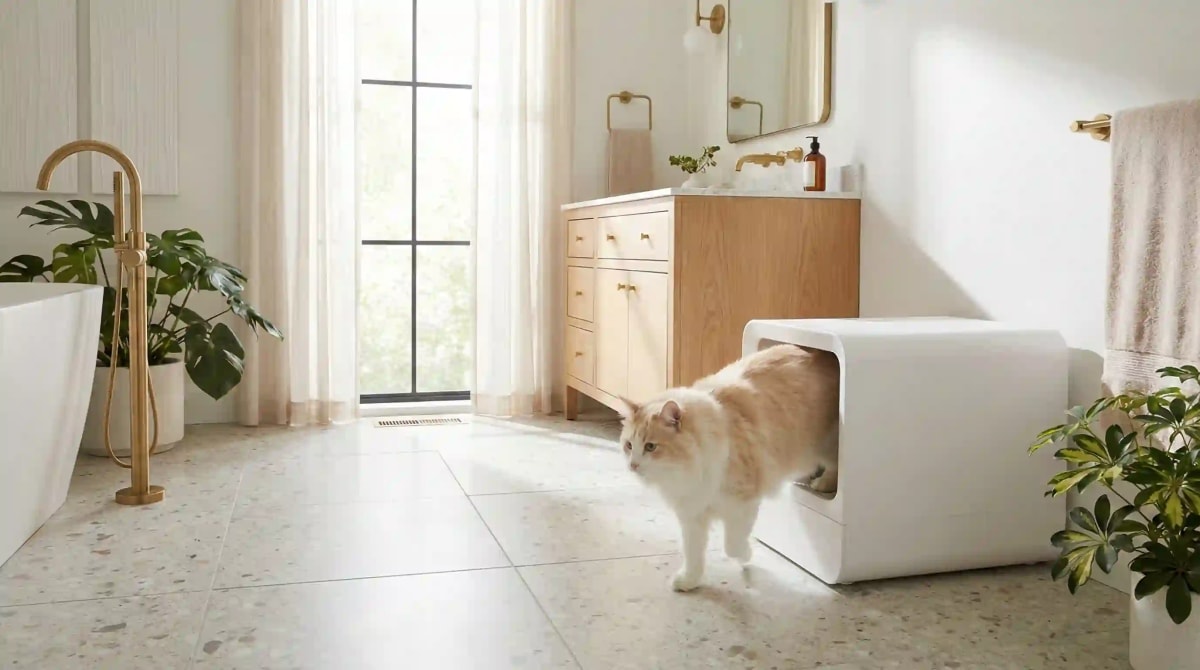
Three cats in a one-bedroom apartment is where cat ownership stops being casual.
With one cat, a lot of bad layout decisions stay hidden. With two, you can still get away with some overlap. With three, the apartment tells the truth very quickly.
If the litter boxes are badly placed, you feel it. If the feeding setup creates pressure, you feel it. If there is no vertical space, no escape route, and no private corner, the cats feel it first and then you feel it second.
That is why managing three cats in a one-bedroom apartment is not mainly about square footage. It is about how well the apartment is divided into usable cat zones.
The good news is that it can work.
But it only works when the space is intentional.
Key Takeaways
- Three cats need zones, not just floor space: In a one-bedroom apartment, the layout matters more than the number on the lease.
- Resource separation is everything: Litter, food, water, rest, and escape paths cannot all live in one corner.
- Vertical space is part of the square footage: A wall shelf, tree, or perch changes the social pressure of the room.
- If the setup feels tight to you, it feels tighter to the cats: Small friction points become behavior problems fast in a three-cat home.
1. Start by asking the honest question
Before talking about solutions, ask the real question:
Are you managing three cats, or are you just fitting three cats into a one-bedroom apartment and hoping the personalities work it out?
Those are not the same thing.
Three cats can absolutely live well in a one-bedroom home. But only if the apartment functions like a system.
That means they need room to pass each other without friction, places to eat without social pressure, places to eliminate without being cornered, and places to rest without being followed constantly.
If you have not read it yet, this is still the right starting point:
2. Divide the apartment into zones
In a one-bedroom apartment, the biggest mistake is thinking in rooms only.
Do not just think in human room labels like living room, bedroom, bathroom, and kitchen.
Think in cat zones instead: a feeding zone, a litter zone, a quiet resting zone, a vertical zone, and at least one neutral passing zone where nobody gets trapped or stared down.
This matters because cats do not experience space the way humans do. They care less about the official room label and more about whether a zone feels blocked, loud, exposed, or contested.
For three cats, one-bedroom management usually gets easier the moment you stop trying to make one area do everything.

3. Litter cannot all live in one bathroom corner
This is where many one-bedroom setups fail.
People think:
"I will keep all the litter in the bathroom so the apartment stays cleaner."
That sounds tidy for you. It often works badly for the cats.
If three cats all depend on one bathroom zone, you create traffic jams, guarding, ambush points, and one bad social experience that can poison the whole litter setup.
In a one-bedroom apartment, the better goal is not "hide all the litter."
It is "spread the litter problem into usable, low-conflict zones."
If you want the detailed litter logic, this is the direct companion article:
4. Feeding stations should not sit side by side by default
With three cats, food becomes social architecture.
If all bowls are lined up in one neat row, it may look organized to you, but it can create silent pressure between the cats. One hovers. One gulps. One walks away halfway through eating. Then it starts looking like someone is "picky" when really they are just uncomfortable.
In practice, feeding works better when at least one bowl is visually separated, one cat can eat without another standing over them, food is not right beside litter, and water sits a little away from the feeding area.
That is why this article pairs directly with the food-placement guide:
5. Vertical space is not optional with 3 cats
This is the biggest mindset shift.
If you have three cats in a one-bedroom apartment, the floor alone is not enough.
Vertical space is what turns a crowded apartment into a workable one.
It gives cats alternate routes, lookout points, places to disengage, and private rest above floor-level movement.
Without vertical options, every disagreement happens on the same plane. Every pass-through becomes face to face. Every active cat can bother every resting cat much more easily.
With even a modest vertical setup, the whole social map changes.
That does not mean your home needs to become a cat obstacle course. It means at least a few pieces of upward territory should exist on purpose.
The Good
- +Wall shelves and trees create escape routes without taking extra floor space.
- +A perch near a window gives a high-value neutral zone.
- +Vertical rest spots reduce floor-level tension between cats.
The Bad
- -Without vertical space, one bold cat can dominate too much of the apartment.
- -Floor-only layouts make rest and movement collide constantly.
- -A beautiful apartment with nowhere to climb often becomes a tense apartment.
If you need the enrichment layer behind this, read:
6. The one-bedroom rule: create one true quiet zone
In a three-cat home, not every zone should be active.
One of the best things you can do is create one area that stays calm on purpose. Usually that means a corner of the bedroom, one high perch in the living area, or a bed or cubby that does not sit in the main traffic line.
This gives the most sensitive cat a place to regulate.
That does not mean only one cat will use it. It means the apartment needs at least one part that feels quieter, less exposed, and less socially busy than the rest.
In a one-bedroom layout, that quiet zone often matters more than buying another random toy.
7. Watch the signs that the apartment is running too tight
The warning signs are rarely dramatic at first.
Most of the time, a too-tight three-cat setup shows up as friction. One cat starts eating faster. One stops using the best resting spots. One starts blocking hallways or doorways. One becomes louder or clingier. Accidents or tension start showing up around litter or feeding areas.
If you see those signs, do not jump straight to blaming personality.
Often the space itself is creating the problem.
The right response is usually environmental. Separate a resource. Move a box. Add height. Create another rest zone. Reduce congestion in one area.

8. What a workable one-bedroom setup usually looks like
There is no perfect universal map, but most workable three-cat one-bedroom setups share the same shape.
The Good
- +Litter is split across more than one zone.
- +Feeding is not all in one straight line.
- +There is at least one strong vertical area in the living space.
- +The bedroom still keeps one quiet rest zone.
- +Movement paths stay open instead of getting blocked by furniture.
The Bad
- -All litter is hidden in one bathroom corner.
- -All bowls sit side by side in one visible station.
- -Everything important happens on the floor.
- -There is no calm zone where a sensitive cat can disengage.
- -The apartment looks tidy to humans but socially cramped to cats.
The goal is not to make the apartment look like a shelter.
The goal is to make it easier for three cats to live parallel lives inside the same small footprint.
Final thoughts
Managing three cats in a one-bedroom apartment is possible.
But it stops working when everything important is stacked into the same few feet of space.
The apartment has to create separation, not just containment.
If you spread resources, build upward, and protect at least one calm zone, three cats can live in a one-bedroom home much more peacefully than people expect.
If you do not, the apartment starts feeling crowded long before the lease says it is.
Frequently Asked Questions
Yes, they can, but only if the layout is intentional. The biggest factors are resource placement, vertical space, and whether each cat has enough room to pass, rest, and eat without constant pressure.
The ideal number is still four. In a one-bedroom apartment, placement matters just as much as the count, because putting every box in one bathroom corner often creates conflict.
Start with the environment. Separate food stations, spread litter zones, add vertical territory, and create at least one true quiet area. Many 'fights' in small apartments are actually layout stress.
Trying to keep every resource in one convenient area for humans. That usually creates traffic, guarding, and silent pressure between the cats.