You stand up to get water, and your cat appears.
You walk to the bathroom, and your cat appears.
You go to bed, switch sides, open a drawer, or sit down for two quiet seconds, and somehow your cat is already there like they knew your plan before you did.
If your cat follows you everywhere, it can feel sweet, funny, flattering, and a little unsettling all at once.
Most of the time, this behavior is completely normal.
Cats are not as distant as people like to pretend. They may be more subtle than dogs, but many of them are deeply tuned into your habits, your movement, and your role in their little ecosystem.
The real question is not just:
"Why does my cat follow me?"
It is:
"Is my cat following me because they are bonded, curious, bored, or stressed?"
That is where the answer gets useful.
Key Takeaways
- Following is often social behavior: Many cats shadow the person they trust most.
- Routine matters: Your cat learns that your movement predicts food, play, or attention.
- Some following is boredom in disguise: In a low-stimulation home, you become the main event.
- Sudden clinginess can be a signal: If the behavior changes fast, check for stress, pain, or anxiety too.
1. Your cat sees you as the center of the territory
In your cat's mind, you are not just "the owner."
You are:
- the food source
- the door opener
- the routine anchor
- the warm body
- the most predictable moving object in the whole home
That means your movements matter.
When you stand up, your cat does not just see a random action. They see a possible event:
- food might happen
- a door might open
- play might start
- something interesting might change
So they follow.
This is especially common in indoor cats whose world is small and structured. If most interesting things in the home happen because you move first, then tracking you becomes smart behavior.
2. They may simply like you more than you think
Sometimes the answer is the softest one.
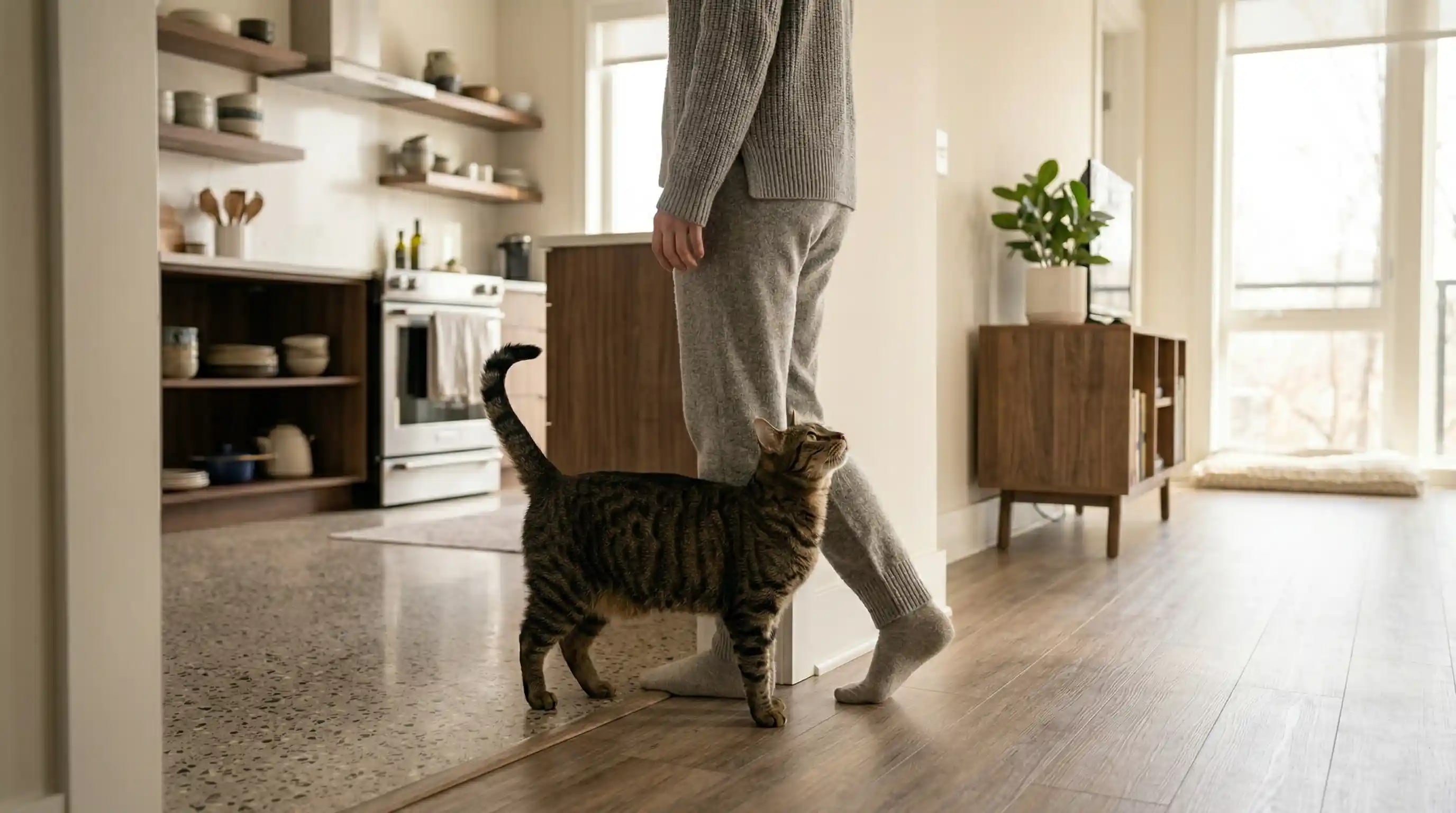
Your cat follows you because they enjoy being near you.
Cats often show attachment through proximity instead of dramatic affection. They may not jump all over you like a dog, but they will quietly place themselves in your orbit over and over again.
This kind of following often comes with other signs of trust:
- slow blinking
- sleeping near you
- sitting with their back to you
- greeting you at the door
- staying in the same room even when nothing exciting is happening
If that sounds familiar, this is worth reading next:
3. You accidentally trained them to do it
Cats are excellent pattern readers.
They do not need formal training to connect one event to another. If your movement often leads to a reward, they learn fast.
For example:
- you stand up, then feed them
- you walk to the kitchen, then open a can
- you go into the bedroom, then cuddle on the bed
- you head toward a cabinet, then a toy comes out
Very quickly, "follow the human" becomes a profitable habit.
This does not mean your cat is manipulative. It just means they are observant.
If your cat mainly follows you near food areas or at predictable times of day, routine learning is probably a big part of it.
4. Bored cats follow movement because movement is interesting
Sometimes your cat is not being clingy.
They are being under-stimulated.
In a quiet apartment, especially a small one, there may not be much happening during the day. No prey, no changing outdoor smells, no shifting social group. That makes your movement one of the most exciting things in the environment.
So your cat follows because you are the best entertainment available.
This is even more likely if your cat also:
- ambushes your ankles
- yells when you stop interacting
- knocks things over after you sit down
- becomes more intense in the evening
That usually points to a cat who needs more hunting, climbing, and environmental change, not just more petting.
5. Bathroom following is usually about curiosity, not mystery
Yes, a lot of cats follow people to the bathroom.
No, it is usually not because they are weirdly obsessed with bathroom culture.
Bathrooms are interesting for simple reasons:
- you close the door, which makes the room feel exclusive
- the space is small, so your cat can stay close
- sinks, tubs, and running water attract curiosity
- your attention is less divided there than in the rest of the house
To a cat, the bathroom is often just another temporary "event zone."
Also, if you normally move through the house and then suddenly disappear behind a door, your cat may simply want to keep track of where you went.
6. If the following became sudden, do not ignore that
This is the part people miss.
Some cats have always been little shadows. That is one thing.
But if your cat suddenly becomes much more clingy, that can point to something else:
- stress
- insecurity
- pain
- aging-related confusion
- illness
- separation-related anxiety
What matters is the change.
Ask yourself:
- Has my cat always followed me like this?
- Is it happening more at night?
- Did it start after a move, new pet, visitor, or work schedule change?
- Are there other symptoms too?
If the following comes with vocalizing, restlessness, or distress when you leave, it may be closer to anxiety than affection.
7. How to tell if it is normal attachment or a problem
Here is the simple version:
Usually normal
- your cat follows you calmly
- they settle once they arrive
- they still eat, groom, sleep, and play normally
- they do not panic when you leave
- the behavior has been consistent for a long time
More concerning
- they seem distressed if they lose sight of you
- they cry or pace when you leave a room
- the behavior appeared suddenly
- they also seem more withdrawn, irritable, or tired
- there are litter box or appetite changes at the same time
That does not always mean emergency. It just means the following behavior should be read in context, not treated like a cute isolated quirk.

What to do if your cat follows you constantly
If the behavior is normal and calm, you usually do not need to stop it.
But if it feels excessive, the best fix is not pushing the cat away. It is improving the environment around them.
Start with:
- more short play sessions
- better window access or vertical space
- puzzle feeding or foraging
- more predictable routines
- a few safe resting zones that are not always right beside you
The goal is not to make your cat love you less.
The goal is to make sure you are not their only source of stimulation and security.
Final thoughts
So, why does your cat follow you everywhere?
Usually because you matter.
You are the center of their routine, their safest social connection, and the thing most likely to make life interesting. For many cats, shadowing you from room to room is a very normal mix of affection, curiosity, and habit.
The only time it becomes a real concern is when it changes suddenly or starts looking more like distress than companionship.
If your cat follows you calmly and then curls up nearby, that is not a warning sign.
That is just your tiny supervisor making sure the household runs correctly.